I’ve been thinking about AI a lot recently. Which isn’t news, because who isn’t?
I recently redesigned my website using Claude. My words, Claude’s code. I’ve built agents to keep me organized and installed skills to help my productivity. And like most people, I’m sitting with the bigger questions too: the security implications, the environmental cost, what we’re actually building toward.
But what I keep coming back to is leadership. Specifically, what AI demands of the humans still in the room.
The good news is that the skills leaders need aren’t new. The ability to think clearly under pressure, communicate with intention, build trust, navigate uncertainty, generate new possibilities, share wisdom. None of that is new. What has changed is the speed at which information is arriving, and the pressure that comes with it.
And here’s what we know about pressure: it puts leadership on autopilot. Not because leaders stop caring. Because the brain reaches for what has worked before. The patterns run before the decision does.
The mirror
Sam Isaacson, a coaching technology and strategy consultant, recently wrote an article on LinkedIn that intersects with what I’m seeing. He argues that AI is a better mirror than it is a predictor. It doesn’t do anything new. It amplifies what we already are. Leaders trained to optimize for profit will use AI to optimize harder for profit. The technology doesn’t change the direction. It accelerates it.
He’s right. And his answer is character, a return to classical virtues. Wisdom, integrity, kindness, bravery, discipline. I agree these matter.
But I’d push the mirror further. AI doesn’t only reflect who we are. It reflects how we operate. Including the parts we can’t see.
That’s the piece character doesn’t reach. You can be a person of genuine integrity and still walk into a high-stakes meeting running entirely on pattern. Most leaders do. The virtues are there. The awareness isn’t.
What autopilot actually looks like
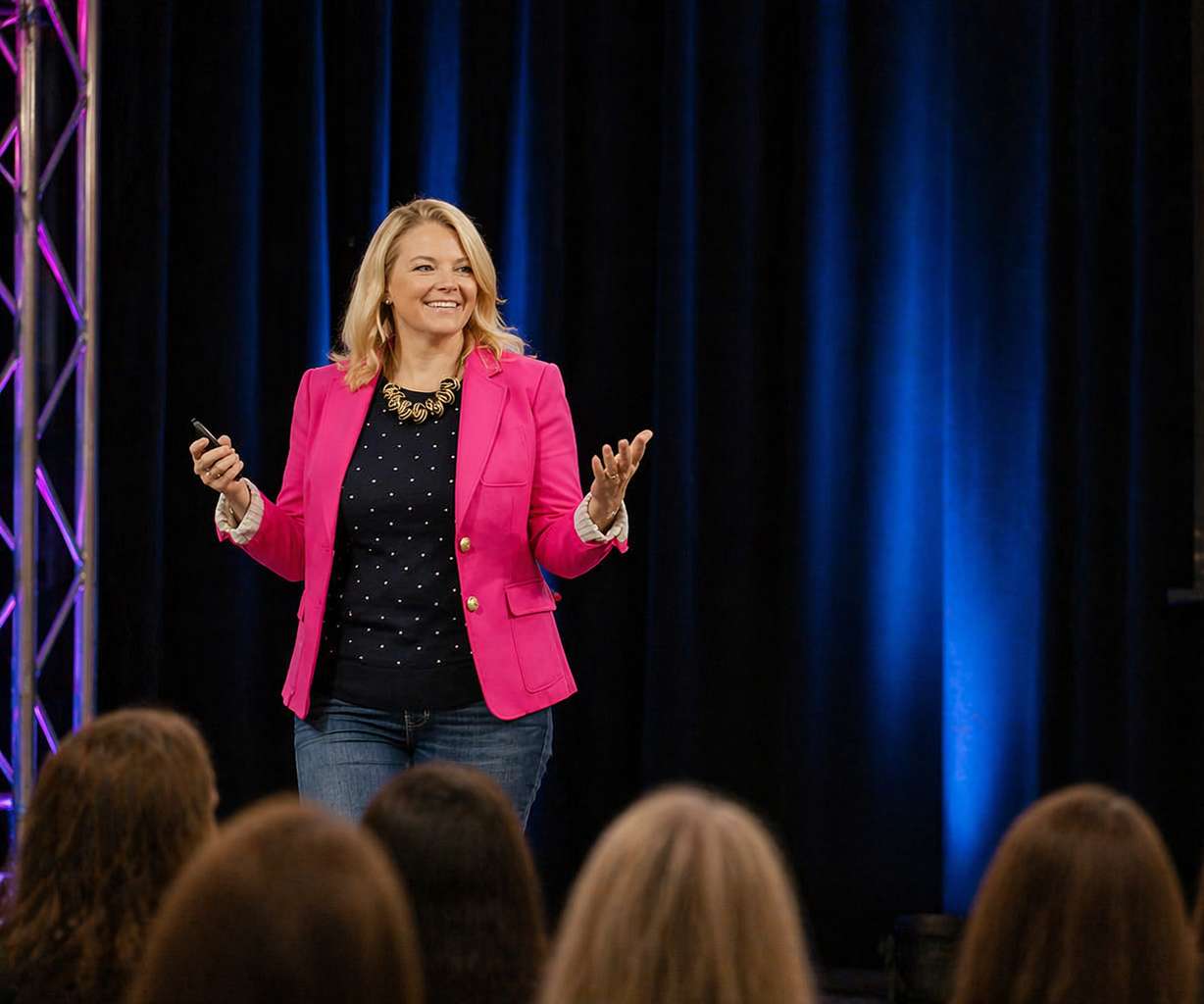
At the Women in Defense National Conference last month, I ran a leadership simulation. Regional power grid down. 600,000 people without power. Military installations, hospitals, defense contractors affected. An AI-generated threat assessment adding another layer of uncertainty. And a meeting in minutes where the room is looking to you for next steps.
What do you recommend?
The room split six ways. Same crisis, same information, same stakes. Six completely different instincts.
Some reached for more information. Some wanted to assemble the right people. Some moved to take control. Some wanted to escalate immediately. Some wanted to get into action. Some challenged whether the room was asking the right question at all.
None of those instincts were wrong. Each represents a genuine strength. The problem is when our instincts run without awareness, when a different response might serve the situation better. Most leaders don’t know they’re running on autopilot until after the meeting is over.
Viktor Frankl wrote that between stimulus and response there is a space. In that space is our power to choose our response. In our response lies our growth and our freedom.
AI keeps compressing that space. More information arrives faster. Decisions are demanded sooner. The window between stimulus and response gets smaller. And so our patterns fill in.
A practice, not a personality
So if the window between stimulus and response is getting smaller, leaders need a practice to intentionally create space so that they can interrupt the autopilot.
What I’ve seen work, in boardrooms, briefings, and executive coaching sessions, is something simpler than a character overhaul. One practice, used before you react, respond, or decide.
I call it the Power of the Pause.
It can take fifteen seconds or five minutes. The goal is not to stop progress. The goal is to pause and answer three questions: What am I assuming? What is driving my decision? What might I not be seeing?
Those questions don’t make the decision for you. They create the space Frankl described. They return you to the driver’s seat.
What the room needs from you
When the room looks to you, they are not only looking for an answer. They are looking for evidence that someone in the room is actually thinking.
That is what human-powered leadership means in an age where AI can produce an answer faster than you can form a question. Not that you resist the technology. That you remain the one who knows when to trust it, when to question it, and what it cannot see.
The capability AI cannot replicate is the practiced ability to notice your own patterns, interrupt them when necessary, and choose your response on purpose.
The space is real. The Power of the Pause makes it yours.
Vamonos,
Suzanne
Suzanne Roske is a leadership and life coach, speaker, former PwC partner, and founder of Vamonos Executive Coaching. She helps high-achieving women, executives, and leadership teams reconnect with themselves and lead with greater intention.